
‘My face looks like it used to’
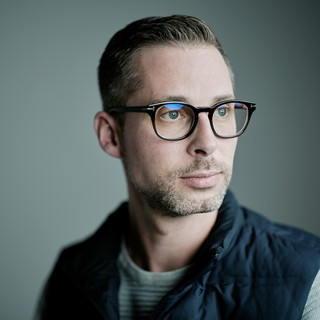
To remove a tumour, two doctors at Aarau Cantonal Hospital reconstructed Stephanie Zihlmann’s lower jaw using part of the patient’s fibula.

Stephanie Zihlmann is not in any pain when she visits her dentist for a routine check-up in May 2023. The dentist discovers that the 34-year-old woman from Gränichen in the canton of Aargau has a wisdom tooth that has erupted in her lower left jaw. He refers the qualified nurse – now a vocational college teacher – to the Department of Oral and Maxillofacial Surgery at Aarau Cantonal Hospital (KSA). There, following a CT scan, the married mother of two is diagnosed with a walnut-sized tumour in her lower left jaw, situated next to the misaligned tooth. After the biopsy, she breathes a sigh of relief: the tumour is benign! Yet Stephanie Zihlmann is bewildered. “I’m young and fit, I’ve always lived a healthy lifestyle, I’ve never been ill,” she thinks to herself.
The bigger shock was yet to come. The patient sat down with the doctors in charge, who have been carrying out complex facial reconstructions at the KSA for years: Professor Philipp Metzler, 47, Senior Consultant in Oral and Maxillofacial Surgery, and PD Dr Holger Klein, 42, Senior Consultant in Plastic and Hand Surgery, explained the extent of the treatment to her. In a complex operation, a large section of her left lower jaw, along with the corresponding teeth, would have to be removed, and the jaw reconstructed using a section of her left fibula. Stephanie Zihlmann, a passionate volleyball player, recalls: “My main concern was that my fibula would be removed and I didn’t know whether I’d still be able to play sport as actively as before.” There was something else worrying her: “I was afraid that facial nerves might be damaged during the operation and that I would suffer from facial paralysis afterwards.”
The operation requires intensive preparation. Using digital planning, Professor Metzler determines the extent of the jawbone and the left fibula to be removed – this is then transferred to the operating theatre using 3D models and surgical templates.
In June 2023, the surgical procedure takes place, carried out by a twelve-strong interdisciplinary team. Whilst Professor Metzler removes the lower jaw along with the tumour, Dr Klein cuts the required 16-centimetre-long section of bone from the left fibula: the two surgeons then use this to reconstruct the lower jaw, securing the bones with three titanium plates. The blood supply to the transplanted bone graft is ensured by connecting the blood vessels to the carotid artery – otherwise the graft would not survive. As the mandibular nerve, which is responsible for sensation in the lower lip, runs through the tumour, this nerve must also be removed and replaced with one taken from the exposed lower leg. The bone segment removed from the fibula is not replaced. Dr Klein: “The tibia can support a person’s body weight without any problems.” The successful operation takes eight hours. “A masterstroke,” says Stephanie Zihlmann.
The patient will remain at the KSA for another week. The left side of her face is severely swollen during the first few days. “It was awful! I could hardly open my mouth at all and was only allowed to have liquid food.” After a set period, including at home, she will then be able to eat puréed food. Stephanie Zihlmann has no feeling in her lower lip or chin. “It was strange at first. I had a mirror in front of me whilst eating. Eating was uncomfortable for me, and I lost a lot of weight. Nowadays, I just chew on the right-hand side of my mouth.”

For the first two weeks after the operation, Stephanie Zihlmann needs walking aids; she is only allowed to put very little weight on her left leg. From then on, she attends physiotherapy twice a week and goes to the gym once a week to do stabilisation exercises. “The training got me back on my feet quickly.” Three months after her stay in hospital, she ventures back to volleyball training for the first time – wearing a support bandage. “I was very self-conscious; I didn’t quite trust my body yet. It’s strange knowing that I’m living without a fibula. There were plenty of difficult evenings when I felt sad because I wasn’t as fit as I used to be. My husband always cheered me up.” Today, the woman from Aargau can jump and block again freely and pain-free in volleyball training. “But I’m not back to my previous level of performance yet.”
The 30-centimetre-long scar on her lower leg doesn’t bother her. The one under her chin, six centimetres long, is barely visible. People who know the story behind the operation say: “If you didn’t know, you wouldn’t be able to tell.” Stephanie Zihlmann is happy and grateful. “My face looks just as it used to. The whole experience has made me more humble.”
Even now, she is still unable to open her mouth fully; she can barely feel her lips and chin on the left-hand side – the nerve needs time to recover. A few weeks ago, Professor Metzler removed one of the three titanium plates. In May, the woman from Aargau will be back at the KSA: that’s when her oral surgeon, Metzler, will fit her with dental implants. And a few weeks later, he’ll fit the crowns onto them. Stephanie Zihlmann: “Then I’ll finally be able to bite properly on both sides again.”
CHECK — Replace like with like
“The mouth, jaw and face are important for chewing and swallowing food, for speaking, for facial expressions and for one’s appearance,” says Professor Philipp Metzler, Deputy Chief Physician at Aarau Cantonal Hospital. Together with his colleague at KSA, Associate Professor Dr Holger Klein, he operates on 30 to 40 patients each year whose faces have been disfigured by accidents and tumours. Dr Klein: “Our aim is to restore the original shape, function and appearance using tissue from other parts of the body – in line with the fundamental principle of plastic surgery: replacing like with like. This enables those affected to regain their original quality of life as quickly as possible.”
Published in Schweizer Illustrierte on 28 March 2024 by Thomas Kutschera, photos: Joseph Khakshouri
Comments